Ram Shalaka guidance for a clear question
Shri Ram Shalaka Prashnavali
Seek devotional guidance for your question through Shri Ram Shalaka Prashnavali, also known as Ramayan Prashnavali, with the meaning and context of each chaupai from Shri Ramcharitmanas.
Explore all verses
This page is in English. हिंदी में राम शलाका प्रश्नावली का उपयोग करें


A simple devotional flow
How to use the Shri Ram Shalaka Prashnavali:
Hold a clear question in mind, then use the Ram Shalaka grid with faith. These steps help the Shri Ram Shalaka Prashnavali experience stay calm, devotional, and easier to interpret.
- Keep the practice focusedAsk only one question per day and avoid turning the experience into a casual game or repeated experiment.
- Receive the answer with faithApproach Shri Ram Shalaka with sincerity and read the answer as devotional guidance rather than as instant certainty.
- Keep practical judgment aliveThis is a tool for guidance, but important life decisions still require reflection, responsibility, and practical wisdom.
- 1First of all, invoke Lord Shri Ram in your heart and maintain a positive mindset.
- 2Formulate your question clearly and precisely in your mind. Avoid asking complex or ambiguous questions.
- 3When you are ready, click the Show Shalaka Prashnavali Grid button above to display the grid.
- 4Close your eyes, remember Shri Ram, and place your finger anywhere on the grid without trying to choose a particular letter.
- 5The corresponding verse (chaupai) from the Shri Ramcharitmanas , along with the answer, will be immediately displayed to guide you on your question.
Guidance rooted in Shri Ramcharitmanas
What is Shri Ram Shalaka Prashnavali?
Shri Ram Shalaka Prashnavali, also searched as Ramayan Prashnavali, is a traditional way of seeking guidance through selected chaupais from Shri Ramcharitmanas. It is best approached not as instant fortune telling, but as a devotional aid for reflection, prayer, and clearer understanding.
- Approach it with faithKeep your mind calm before asking a question and avoid using the Ram Shalaka app casually as a game. The experience is more meaningful when approached with sincerity and focus.
- Read the full contextEach Shri Ram Shalaka answer appears as a verse, but its meaning becomes clearer through its kanda, context, and explanation. The verse pages help you go beyond the single line.
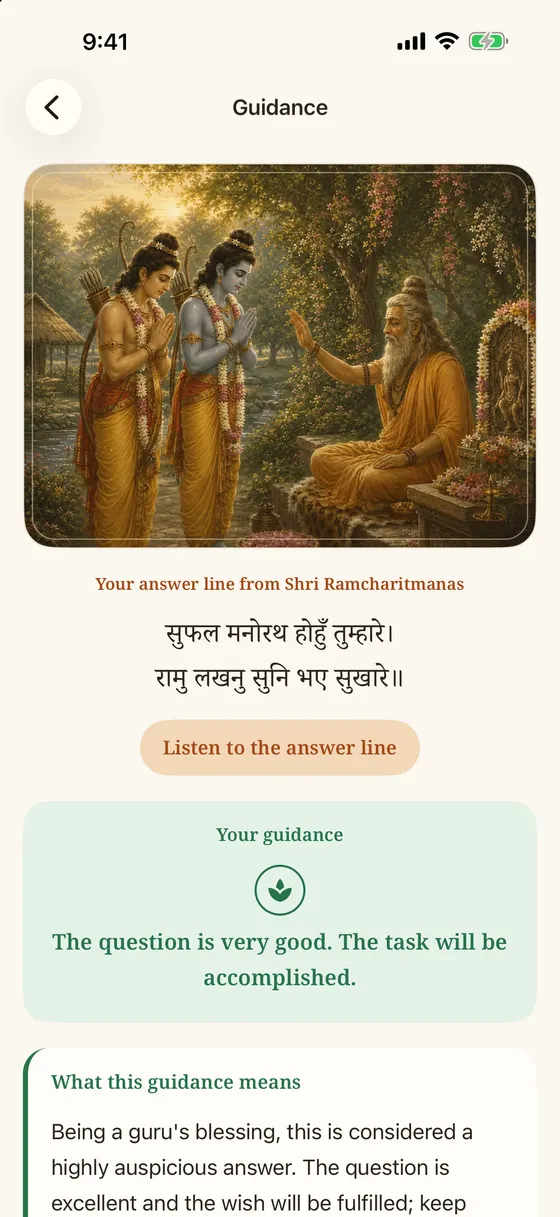
- Answers appear in HindiThe revealed answer appears as a Hindi chaupai line. The verse page then gives you meaning, context, and audio so the guidance is easier to understand.
One practice, several names
Why is it also called Ramcharitmanas Prashnavali or Ramayan Prashnavali?
Every answer of Shri Ram Shalaka Prashnavali is a chaupai line from the Shri Ramcharitmanas of Goswami Tulsidas. Because each answer comes from that text, the practice is widely searched as Ramcharitmanas Prashnavali. It is also called Ramayan Prashnavali or Ram Prashnavali, because the Ramcharitmanas is itself popularly known as the Tulsi Ramayan.
- The source is the RamcharitmanasThe nine answer lines are drawn from eight complete chaupais spread across the kandas of the Shri Ramcharitmanas. Nothing outside that text is used.
- Each name describes one partShalaka is the thin stick or straw once rested on the printed table. Prashnavali is the question-and-answer practice that uses it. Ramcharitmanas and Ramayan both name the source every answer is drawn from.
- Answers carry their contextBecause each answer is a Ramcharitmanas line, it reads best with its kanda and prasang rather than on its own. Every verse page gives that context, the word meanings, and audio.
Common questions
Common questions about Ram Shalaka Prashnavali
Quick answers about Shri Ram Shalaka Prashnavali, how it relates to Ramayan Prashnavali, and how to use it well.
Yes. Ram Shalaka, Shri Ram Shalaka Prashnavali, Ramayan Prashnavali and Ramcharitmanas Prashnavali are different names for the same devotional practice: seeking guidance through selected chaupais of Shri Ramcharitmanas, just as this app does.
Ramcharitmanas Prashnavali is another name for this same tradition, used because every answer comes from a chaupai of Goswami Tulsidas's Shri Ramcharitmanas. The nine answer lines are drawn from eight chaupais spread across its kandas.
Hold one clear question in your mind, remember Shri Ram, and touch any one cell of the grid with faith. The pattern leads you to one of the nine answer chaupais, which you can then read with its context and meaning.
The answer first appears as a Hindi chaupai from Shri Ramcharitmanas. On the English pages, the verse page then explains its context and meaning in English as well.
Not directly. Ram Shalaka Prashnavali offers guidance through a chaupai rather than a simple yes or no. Some answers read as clear encouragement, such as one saying the task will be accomplished, while others counsel patience or caution. Read the full verse with its context to understand what it suggests for your question.
Yes. The answer itself appears as a Hindi chaupai, because that is how it is written in the Shri Ramcharitmanas. Every verse page on the English site then gives the transliteration, the word meanings, and the full explanation in English.
Yes. The printable chart page shows the complete 15×15 table of 225 letters with all nine answers, their meanings, and the eight source chaupais. You can print it or save it as a PDF from your browser.
Printable Ram Shalaka Prashnavali chart
The 15×15 chart with all answers and meanings
The online Prashnavali uses this traditional chart of 225 letters. Here you can view, print, or download it as a PDF, with all nine answers, their meanings, and the eight source chaupais from Shri Ramcharitmanas.
Go deeper
Understand Shri Ram Shalaka beyond the quick answer
If you want more than the surface result, these guide pages explain the tradition behind Shri Ram Shalaka Prashnavali and how to interpret the answer well.
Take it with you
Get Shri Ram Shalaka on your phone
Use the same calm, devotional practice on Android or iPhone, with the core experience available fully offline.


App Store is a trademark of Apple Inc.; Google Play of Google LLC.
Related Spiritual Apps
Explore our other spiritual apps
If you want a complete Shri Ramcharitmanas reading experience or a curated collection of Subhashitas, these two apps are the best next stop.