This chaupai appears in the Lankakanda section of Shri Ramcharitmanas.
बरुन कुबेर सुरेस समीरा। रन सन्मुख धरि काहुँ न धीरा॥ भुजबल जितेहु काल जम साईं। आजु परेहु अनाथ की नाईं॥
Context: where this chaupai appears in Shri Ramcharitmanas
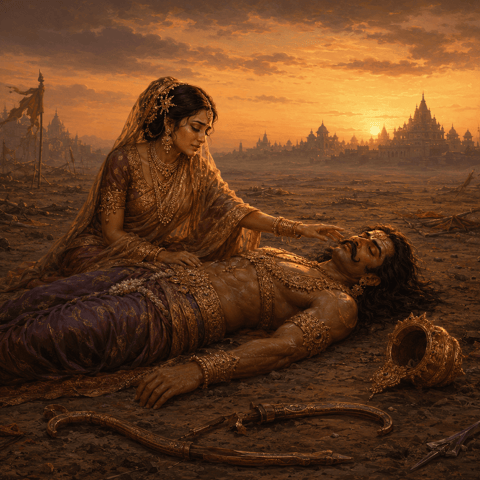
In Lankakand, after Ravan's death, Mandodari laments: the Ravan before whom even gods like Varun, Kuber, Indra, and Vayu could not hold their courage in battle, who by the strength of his arms had conquered even Kaal and Yamraj, O my lord, that same Ravan lies today like an orphan.
Read the complete episode containing this chaupai in Shri Ramcharitmanas, also known as the Tulsi Ramayan.
Read the full episode in Shri RamcharitmanasTransliteration
Barun Kuber Sures Samira. Ran Sanmukh Dhari Kahun Na Dhira.. Bhujbal Jitehu Kal Jam Sain. Aaju Parehu Anath Ki Nain..
In Latin script this chaupai is also written as “Barun Kuber Sures Samira” or “Varun Kuber Suresh Sameera”. The spelling varies; the verse is the same.
Word meanings
- Barun = Varun (god of waters)
- Kuber = god of wealth
- Sures = Indra
- Samira = Vayu, the wind god
- Ran sanmukh = facing him in battle
- Dhira = courage, composure
- Bhujbal = by the strength of arms
- Kal Jam = Kaal and Yamraj
- Sain = lord, master
- Anath ki nain = like an orphan
As a Shalaka answer
This is an unfavourable answer. Even the greatest power and means do not last on the path of arrogance and adharma; that is the warning of this episode. Completion of the work is doubtful; reconsider both the direction and the means.