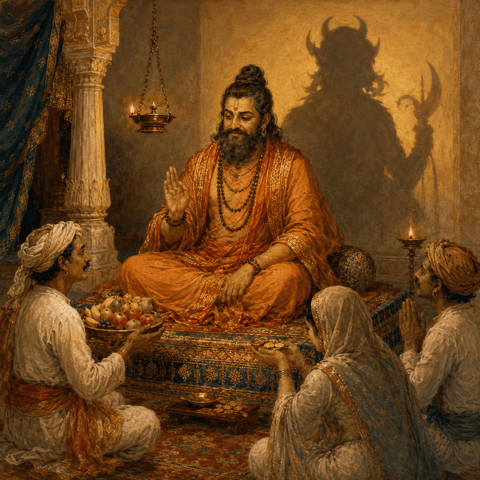
लखि सुबेष जग बंचक जेऊ। बेष प्रताप पूजिअहिं तेऊ॥ उघरहिं अंत न होइ निबाहू। कालनेमि जिमि रावन राहू॥
As a Shalaka answer
This is a cautionary answer. What the matter or person appears to be on the surface is not what it is within, so do not trust appearances. Success is doubtful, so examine everything carefully before proceeding.
Context: where this chaupai appears in Shri Ramcharitmanas
At the beginning of Balkand, Goswami Tulsidas describes the glory of saints and the nature of the wicked. He observes that impostors who put on the beautiful garb of a saint are also worshipped in this world because of that garb. But in the end their deceit is exposed and does not last, as happened with Kalnemi, Ravan, and Rahu.
Read the full episode in Shri RamcharitmanasRead the complete episode containing this chaupai in Shri Ramcharitmanas, also known as the Tulsi Ramayan.Word meanings
- Lakhi
- seeing
- Subesh
- beautiful (saintly) garb
- Banchak
- impostor, deceiver
- Besh pratap
- by the power of the garb
- Pujiahin
- are worshipped
- Ugharahin
- are exposed
- Nibahu
- lasting to the end
- Jimi
- just as
Transliteration
Lakhi Subesh Jag Banchak Jeu। Besh Pratap Pujiahin Teu॥ Ugharahin Ant Na Hoi Nibahu। Kalnemi Jimi Ravan Rahu॥
In Latin script this chaupai is also written as “Ugharahin Ant Na Hoi Nibahu” or “Ughare Ant Na Hoi Nibahu”. The spelling varies; the verse is the same.